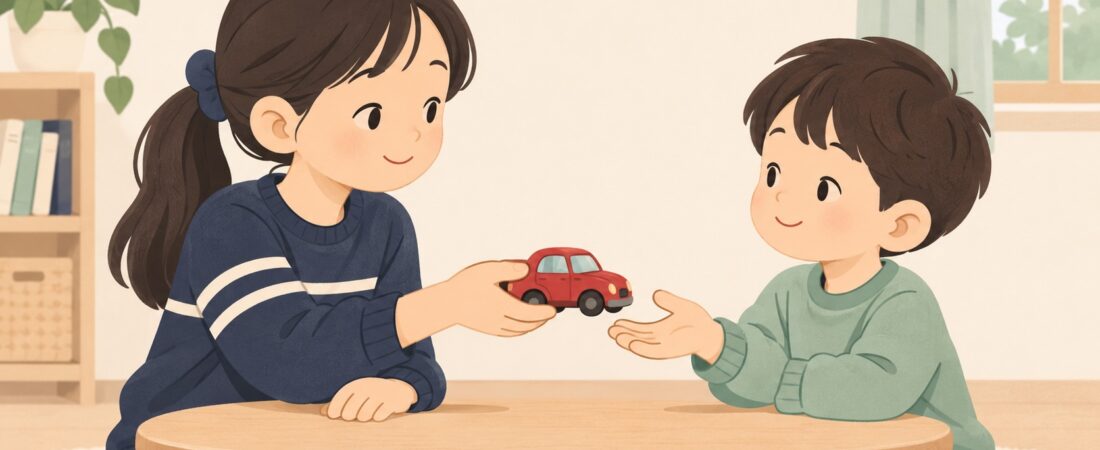
One toy car, two children, and a moment to ask for a turn: you already have a setting for a small Korean conversation. These Korean turn-taking phrases for kids give siblings words for asking, waiting, handing something over, and saying they are not finished yet.
Try them during calm play with a parent nearby. This is a language activity, not a promise to prevent arguments. Children can point, speak English, or ask an adult for help. Access to a toy should never depend on producing a perfect Korean sentence.
Start with a two-phrase exchange
Choose one shared toy and agree on an easy stopping point: one trip down a car ramp, one completed puzzle piece, or one drawing turn. Model 나도 해도 돼? (Can I have a go, too?) and 응, 여기 있어. (Yes, here you go.). Then let the children play. One successful exchange is enough for the first attempt.
Use a shared play item rather than a special possession a child has not agreed to lend. If someone does not want to join, demonstrate with a stuffed animal instead.
Eight phrases for taking turns in Korean
The examples below use casual speech, or 반말, for a familiar sibling relationship where that style is comfortable. Family preferences vary. Polite alternatives appear later in the guide.
- 나도 해도 돼? — Can I have a go, too? Use this to join an activity, such as rolling a car or drawing on a shared board.
- 다음은 내 차례야. — It is my turn next. This describes the agreed order; it is not permission to grab.
- 잠깐만 기다려 줘. — Please wait a moment. Pair it with a visible endpoint, such as finishing the current turn, so “a moment” does not become indefinite.
- 아직 안 끝났어. — I am not finished yet. A child can say this while completing the turn everyone agreed on.
- 다 했어. 이제 네 차례야. — I am done. Now it is your turn. Say it as the toy moves to the next player.
- 응, 여기 있어. — Yes, here you go. In this handover context, 여기 있어 works naturally when offering the item.
- 같이 하자. — Let’s do it together. Use it when the activity really can be shared, such as building one road with several blocks.
- 도와줘. — Help me. Let either child call an adult instead of having to negotiate alone.
A small meaning distinction: 나도 해도 돼? asks to do the activity. If a child wants to borrow a specific object, 이거 빌려도 돼? means “Can I borrow this?” Pointing to the object makes 이거 (“this”) clear.
A sample conversation: older sister and younger brother
This is an invented practice dialogue. In this example, the younger brother calls his older sister 누나. A younger sister would use 언니 for her older sister instead.
Younger brother: 누나, 나도 해도 돼?
Big sister, can I have a go, too?
Older sister: 응. 이거 끝나면 네 차례야.
Yes. When I finish this, it is your turn.
Younger brother: 알겠어.
Okay.
Older sister: 다 했어. 여기 있어.
I am done. Here you go.
Younger brother: 고마워!
Thanks!
Keep the toy moving while you model the words. You do not need to rehearse the whole dialogue or ask the older child to teach the younger one. The adult can supply any missing line.
Activity 1: the one-trip car ramp
You need: one age-appropriate toy car and a short, stable ramp on the floor. A flat road drawn on paper works too.
- Agree that a turn is one trip down the ramp or along the road. Say who will start.
- The waiting player asks 나도 해도 돼? A parent can say the words while the child points.
- After the trip, the first player says 이제 네 차례야 and passes the car.
- Swap roles for a few turns. Stop while the activity still feels enjoyable.
Make it easier: use just 내 차례 (my turn) and 네 차례 (your turn), with a gesture toward each player. Add a little language: let each child choose a destination: 집으로 가자 (Let’s go home) or 공원으로 가자 (Let’s go to the park).
Activity 2: one shared drawing
You need: paper and age-appropriate crayons. Each child can have a crayon; there is no need to create a shortage of supplies.
- Choose a shared scene, such as a house with a garden. Agree that each turn adds one small thing.
- The first child draws a door, flower, or cloud and says 다 했어.
- The next child says 다음은 내 차례야 and adds something.
- If both want to work at once, offer 같이 하자 and decide which area each person will draw in.
The aim is to give the phrases a useful job. If the children prefer separate pictures, let them keep drawing and practice asking to borrow a color instead.
Activity 3: help the puppet find its words
You need: two stuffed animals and one pretend play item.
- Have one animal hold the item. The other reaches toward it, then pauses.
- Offer two possible lines: 나도 해도 돼? or 도와줘. Ask which one the animal could use.
- Let the child answer in either language or speak for one animal.
- Practice both an immediate handover and a short wait: 아직 안 끝났어, followed by 이제 네 차례야 when the turn ends.
Try this away from a real disagreement. If play becomes upsetting, put the language exercise aside and help with the situation first.
Adjust the language to your family
For a child who understands more than they say: provide the phrase once and accept a gesture. You might say “You want a turn—나도 해도 돼?” without requiring repetition.
For children with different Korean levels: give both children an equally useful job. One can say 여기 있어 and the other can use the longer 나도 해도 돼? Neither needs to correct the other.
For polite speech practice: use 나도 해도 돼요? (Can I have a go, too?), 잠깐만 기다려 주세요 (Please wait a moment), and 도와주세요 (Please help me). Choose a consistent style for the particular person and setting; children do not need every variation at once.
For an only child: a parent, cousin, or puppet can take the second role. The same words fit a cooperative game with an adult.
Keep the next session small
After play, notice which phrase had a real use. Repeat that one during the next session rather than introducing all eight again. You might write two phrases on a card for your own reference; reading Hangul is not required to join the activity.
For another setting, choose an activity from our 10 Korean games for kids. The free playtime phrase pack offers a separate set of prompts for play. It is an existing resource, not a printable version of this article.
Frequently asked questions
Should siblings always use casual Korean?
No single choice fits every family. This article uses familiar casual speech for the example siblings. Use the level of politeness your family expects, and model the alternative in the specific setting rather than turning play into a grammar test.
What if my child answers in English?
Respond to the meaning and offer the Korean line naturally. If a child says “My turn next,” you can answer “응, 다음은 네 차례야” (“Yes, your turn is next”). Let play continue without making translation a condition of participation.
What if a child says “not finished” every time?
Return to the concrete endpoint agreed on before play, such as one trip down the ramp. Help the children follow that agreement or choose a different activity. Adding more Korean phrases will not by itself settle a dispute.
Do we need a timer?
No. A visible action, such as adding one puzzle piece, can define a turn. If your family prefers a timer, agree on its use beforehand and keep an adult available to help. The language activity does not require a particular duration.
Which sibling names should we use?
In common Korean usage, a boy calls an older sister 누나 and an older brother 형; a girl calls an older sister 언니 and an older brother 오빠. Younger siblings are often addressed by name. Use the terms that fit the actual speaker and relationship, not a fixed label for every character.
Language reference: Parents can check meanings and listen to available pronunciation recordings in the National Institute of Korean Language’s Korean–English Learners’ Dictionary. Search 차례, 기다리다, 빌리다, 누나, or 언니. The activities and sample dialogue above are original practice suggestions.